
NSW has taken meaningful steps towards a low-emissions future but reaching its legislated climate targets will require greater action.
NSW is already facing the impacts of a changing climate. Last year was the nation’s fourth hottest year since records began, with the average temperature 1.68°C above the 1961–1990 baseline. Australia is among the world’s most climate-exposed countries, facing escalating floods, fires, and extreme heat. The scale of the impacts of climate change depends on the scale of warming and adaptation action.
Our 2026 Annual Progress Report provides an independent assessment of the state’s progress and highlights opportunities to speed up emissions reductions and better prepare communities for escalating climate risks.
Download and read the full report
What you need to know
The pace of decarbonisation must urgently increase
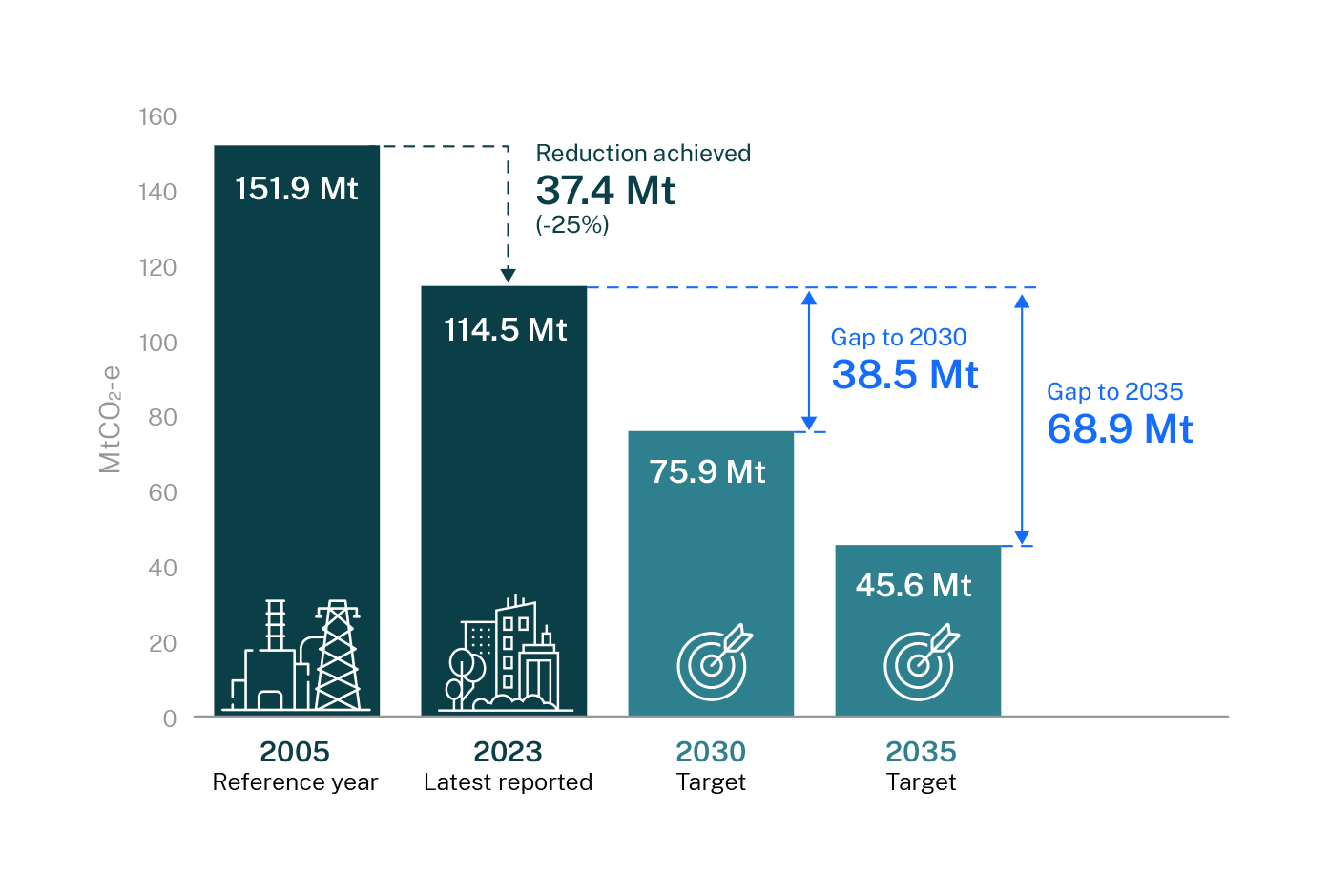

Average decarbonisation rate from 2004-05 to 2022-23

Average decarbonisation rate needed from 2023 until 2030
NSW needs to increase investment in adaptation
NSW must move from planning to delivery in climate adaptation. NSW communities are already living with the realities of climate change through an increase in extreme weather events. To protect our communities, NSW must urgently invest in climate resilience.

How we get back on track
The report includes 8 recommendations to help achieve NSW's climate targets:
Summary
This includes prioritising assessments for renewable energy and industrial decarbonisation projects. There must also be meaningful consideration of the legislated targets for all planning proposals, particularly for coal mines and data centres.
Recommendation 1A
Prioritising planning approval for projects that will contribute to meeting emissions reduction targets, in particular, renewable energy infrastructure and industrial decarbonisation projects.
Recommendation 1B
Ensuring meaningful consideration of NSW’s emissions reduction targets in all NSW Government decisions, particularly in planning assessments of coal mine extensions or expansions, and data centres.
Recommendation 1C
Improving the availability of verified emissions data to enable more accurate monitoring and reporting across supply chains and better inform government and private sector decision-making.
Summary
Fast track the build-out of renewable generation, storage, and transmission and close coal power stations as soon as possible.
Recommendation 2A
Reducing barriers to renewable generation, storage and transmission delivery throughout planning, financing and construction phases.
Recommendation 2B
Improving host communities’ support for new renewable energy and transmission infrastructure, including by requiring meaningful engagement and ensuring benefits to the regions.
Recommendation 2C
Improving energy efficiency of existing facilities and buildings, and accelerating uptake and orchestration of distributed energy resources to put downward pressure on energy bills and reduce the need for large-scale generation, storage and transmission.
Recommendation 2D
Ensuring new industrial loads, especially data centres, rely on additional renewable energy sources and support the timely closure of coal power stations.
Summary
Drive fast, cost-effective emissions reductions through faster uptake of electric vehicles, phasing out gas in buildings, and helping businesses electrify low-to-medium temperature process heat.
Recommendation 3A
Enabling and incentivising faster uptake of passenger and light commercial electric vehicles in NSW, including by ensuring a rapid build out of the statewide charging network (public, residential and commercial), and expanding public transport, walking and cycling.
Recommendation 3B
Planning for and incentivising electrification of trucks and buses, including charging infrastructure along freight corridors.
Recommendation 3C
Phasing out gas use in existing buildings and requiring all-electric new buildings while considering vulnerable people and regulating refrigerants to reduce their climate impact and avoid long-lasting, toxic chemicals.
Recommendation 3D
Driving energy efficiency and improved thermal resilience through mandatory disclosure of performance for all new and existing homes at the point of sale or lease, and minimum standards that support health and thermal safety in a changing climate.
Recommendation 3E
Incentivising electrification of low-to-medium temperature process heat, including by helping businesses understand and adopt electric options and reforming existing schemes to reduce financial barriers.
Summary
Deploy mature abatement options for landfills, upscale methane technology for livestock, and action the findings of the Coal Mining Emissions Spotlight Report. Methane is a strong greenhouse gas and avoiding its release will have an outsized impact on NSW’s emissions.
Recommendation 4A
Developing and delivering policies that implement the findings of the Commission’s Coal Mining Emissions Spotlight Report, in particular Finding 3.
Recommendation 4B
Scaling the low-cost abatement measures identified by the NSW Department of Primary Industries and Regional Development, including biochar, feed additives, manure management and herd management, alongside longer-term pathways for reducing livestock emissions.
Recommendation 4C
Reducing waste emissions by maximising landfill gas capture, reducing total waste generation, and diverting other methane-generating waste from landfills (beyond food and garden organics mandates).
Summary
Some sectors are less mature and need support to improve emissions data, innovate and build new infrastructure to decarbonise in the longer-term.
Recommendation 5A
Focusing policy on existing and new industries that will be competitive in a net zero future and communicating priorities clearly to attract private sector investment, including through supporting innovation, demonstration and scale-up.
Recommendation 5B
Establishing the platforms and new infrastructure for the decarbonisation of heavy freight, aviation and shipping, including options to scale alternative low carbon fuels for aviation and shipping, and shifting road freight to rail.
Recommendation 5C
Improving alignment across agriculture, land use and climate policy frameworks to reduce emissions, focusing on protecting native forests, limiting land clearing, and ensuring land managers can access incentives and financial mechanisms to deliver abatement, resilience and other co-benefits.
Recommendation 5C
Advocating for more transparent and accurate reporting on embodied emissions in the built environment sector, supported by robust carbon tracking and accounting at the product level throughout supply chains.
Recommendation 5D
Leading advocacy for Commonwealth policy changes that support and drive emissions reductions, such as fuel tax credit reform.
Recommendation 5E
Embedding circular economy principles in government policies and programs where they can deliver the greatest reductions in emissions and waste generation.
Recommendation 5F
Developing a credible residual emissions strategy that prioritises avoidance and reduction, establishes a clear role for carbon removals, and minimises the use of offsets by focusing on mechanisms to reduce direct emissions.
Summary
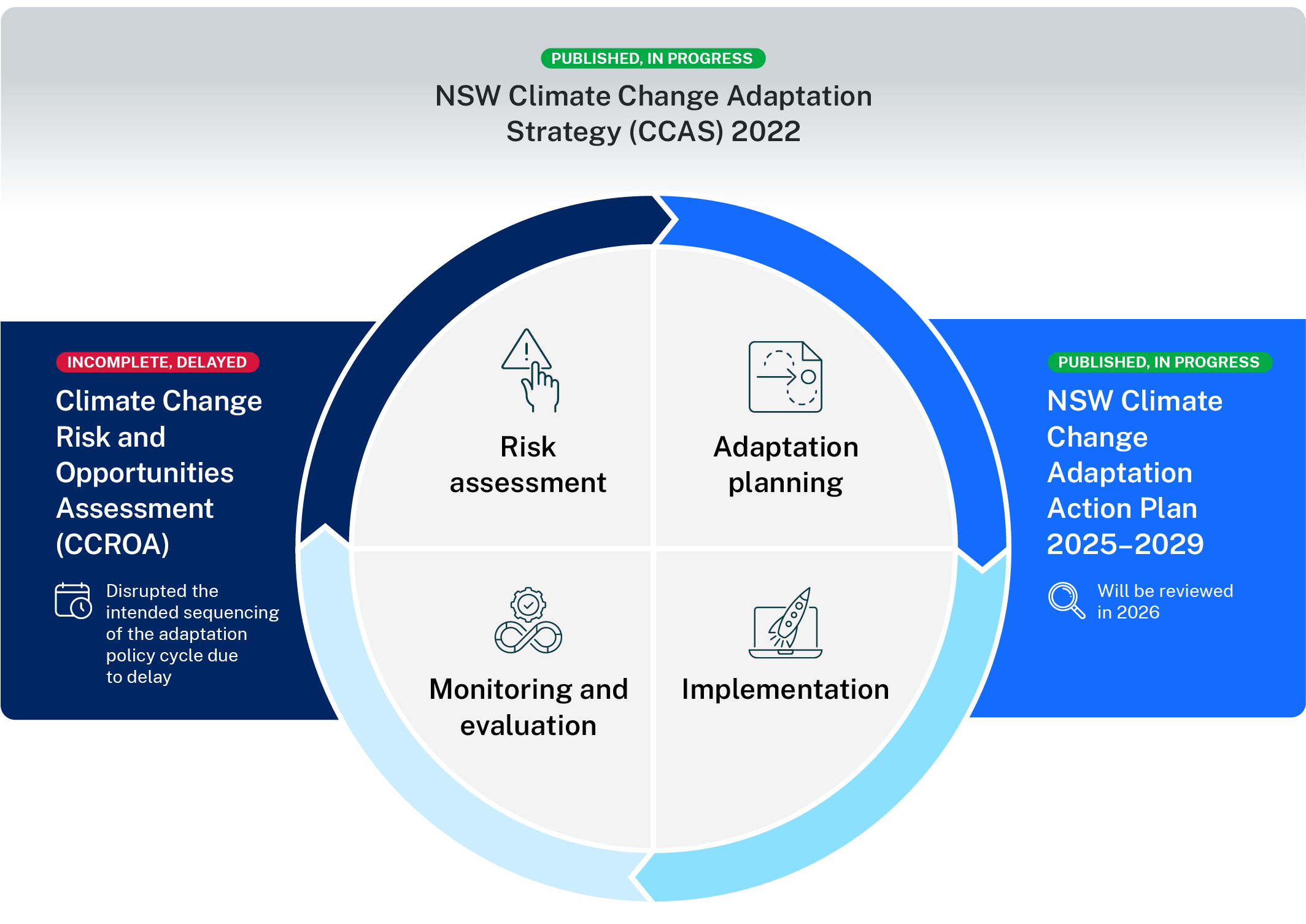
Laying foundations is no longer enough. Timely adaptation action requires clear governance and coordinated policy.
Recommendation 6A
Introducing regulations to clarify roles and responsibilities for adaptation and specify timeframes for statewide climate risk assessments, adaptation action plans and adaptation monitoring and evaluation.
Recommendation 6B
Releasing the Climate Change Risk and Opportunity Assessment as soon as possible. Within 6 months of its release, the findings of an independent evaluation into its development should be published to inform the delivery of future assessments.
Recommendation 6C
Ensuring timely delivery of actions under the Climate Change Adaptation Strategy, State Disaster Mitigation Plan and Climate Change Adaptation Action Plan.
Recommendation 6D
Progressing adaptation activities beyond risk identification toward actions that directly increase resilience to climate risks.
Recommendation 6E
Considering action prioritisation, progress indicators and a greater focus on addressing vulnerability in disadvantaged groups and communities, including First Nations peoples, within its forthcoming review of the Climate Change Adaptation Action Plan.
Recommendation 6F
Implementing actions that address findings from the Commission’s Heat Stress Spotlight Report.
Summary
The increase in the size and nature of climate risks means we need long-term investment in adaptation. Funding needs to consider the agencies and councils on the frontline of protecting communities from climate impacts.
Recommendation 7A
Developing a financing strategy to fund adaptation action which considers the economic benefits of proactive investment, the resourcing needs of agencies and local councils proportionate to their responsibilities, and the appropriate use of different funding sources, including the Climate Change Fund.
Recommendation 7B
Leading advocacy for Commonwealth policy change to address structural gaps in adaptation financing, such as a national adaptation finance strategy to drive state and local-level adaptation action.
Recommendation 7C
Providing visibility of NSW Government expenditure on climate change adaptation through regular reporting, supported by guidance of what is considered in scope of this expenditure.
Summary
Local communities, First Nations communities and councils have strong local knowledge and connections that can drive local and regional emissions reduction and climate resilience.
Recommendation 8A
Embedding First Nations leadership as a core pillar of climate governance, including by responding to the Aboriginal Disaster Resilience Policy Roundtable communique, to strengthen First Nations community resilience across NSW.
Recommendation 8B
Supporting First Nations communities to investigate how the broader use of cultural fire could contribute towards emissions reduction goals through carbon removals and reduce bushfire-related emissions, in addition to improving climate resilience.
Recommendation 8C
Ensuring net zero and sector plans address the diverse specific needs of regions across the state, supporting and resourcing councils to drive the local change necessary for the transition and in meeting the challenges of adapting to climate change.
Recommendation 8D
Providing greater support to local and regional-scale adaptation initiatives, such as capability and coordination support, which considers the differing challenges and contexts of councils.
Recommendation 8E
Considering whether broader climate change adaptation can be adequately addressed at the local and regional scale through the existing framework set out in the Reconstruction Authority Act 2022 (NSW) for disaster adaptation planning.

Every sector has a role to play in emissions reduction

Total emissions
Annual emissions need to fall to 75.9 MtCO2-e by 2030 and 45.6 MtCO2-e by 2035 to meet NSW’s legislated targets.
To help each sector contribute to this goal, NSW Government needs to put in place clear climate policies across all portfolios.
The Commission’s assessment of around 200 state and federal policies is that emissions policy is more developed in some sectors than others, but that it does not yet deliver the rapid emissions reductions required.
In some instances, strong policy signals are missing, while in others the commitments are appropriate but there are issues with the speed of implementation. The below figure provides an overview of the sectors. Policy strengths and challenges for each sector are discussed in more detail in the report.
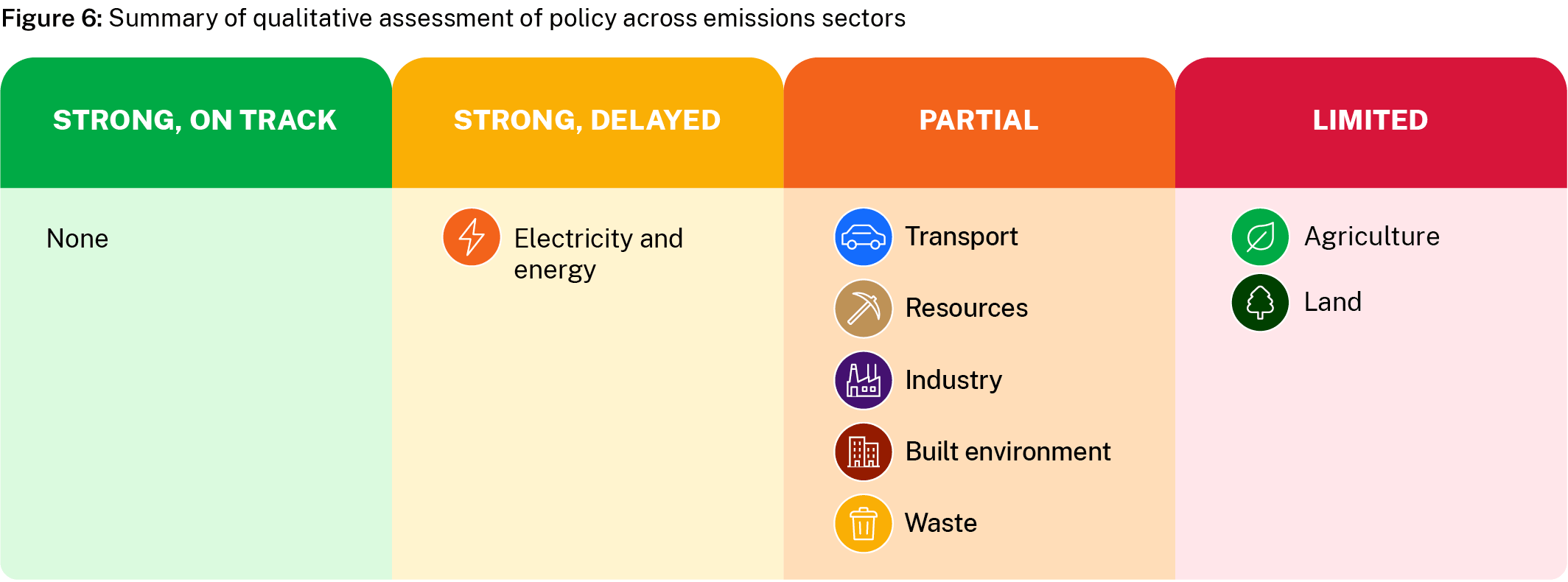
How each sector of the economy is tracking
Electricity and energy
Electricity remains the largest source of emissions in NSW. It is also the sector that is projected to contribute the most to achieving the 2030 and 2035 legislated targets. The sector’s emissions come almost entirely from fossil-fuel based electricity generation, most of which is from coal power generation.
While emissions in the sector continued on a downward trajectory, a much faster decrease is needed to keep NSW’s legislated targets within reach. The electricity sector’s transition away from fossil fuel-based generation also underpins emissions reductions in other sectors through electrification.
Where is this sector at?
The electricity and energy sector generated 43.3 MtCO2-e in emissions in 2022-23. Emissions have decreased by 16.8 MtCO2-e since 2004-05 (a 28% reduction), and 0.8 MtCO2-e (1.8%) from 2021-22. 2022-23 is the fifth consecutive year of decreasing emissions in the sector.
What we found
The electricity sector has reduced emissions for the fifth consecutive year. Home solar battery uptake and new renewable electricity generation both reached record levels in 2025, putting downward pressure on wholesale electricity prices. However, reductions have been slower than needed, considering this sector needs to deliver most of the reductions for the legislated 2030 target and clean electricity is needed to decarbonise other sectors. The policy environment in electricity is well-developed but many projects are delayed.
What can the NSW Government do?
In line with Recommendation 2 of the report, the Commission recommends:
Recommendation 2A: Reducing barriers to renewable generation, storage and transmission delivery throughout planning, financing and construction phases.
Recommendation 2B: Improving host communities’ support for new renewable energy and transmission infrastructure, including by requiring meaningful engagement and ensuring benefits to the regions.
Recommendation 2C: Improving energy efficiency of existing facilities and buildings, and accelerating uptake and orchestration of distributed energy resources to put downward pressure on energy bills and reduce the need for large-scale generation, storage and transmission.
Recommendation 2D: Ensuring new industrial loads, especially data centres, rely on additional renewable energy sources and support the timely closure of coal power stations.
Transport
Most emissions in the transport sector are from light vehicles, where switching to battery electric vehicles is a readily available way to reduce emissions. The other main sources of transport emissions are heavy vehicles, domestic shipping and rail, and domestic aviation.
The transport sector’s emissions increased in 2022–23 and are higher than they were in 2004–05. While uptake of electric vehicles is increasing, emissions in this sector are not moving in the right direction yet.
Where is this sector at?
Emissions levels increased by 11% (2.6 MtCO2-e) since 2004-05, and are rising again after a temporary decline during the COVID-19 pandemic.
What we found
Almost all transport sector emissions are from the combustion of diesel and petrol, with the majority coming from road transport. Over 60% of transport emissions have low-emissions alternatives, primarily in the form of electric vehicles. Electric vehicle uptake needs to continue to increase sharply, and the charging network needs to be expanded at the same time, both for light and heavy vehicles.
Commonwealth vehicle efficiency standards are making a difference, but there are still incentives for diesel use and heavy fossil fuel vehicles. Improved access to public and active transport and better land-use planning also plays a role in decarbonising the sector. Shifting away from imported fossil fuels also has national security benefits.
What can the NSW Government do?
In line with Recommendations 3 and 5 of the report, the Commission recommends:
Recommendation 3A: The NSW Government should enable and incentivise faster uptake of passenger and light commercial EVs in NSW, including by ensuring a rapid build out of the statewide charging network (public, residential and commercial), and expanding public transport, walking and cycling.
Recommendation 3B: The NSW Government should plan for and incentivise electrification of trucks and buses, including charging infrastructure along freight corridors.
Recommendation 5B: The NSW Government should establish the platforms and new infrastructure for the decarbonisation of heavy freight, aviation and shipping, including options to scale alternative low carbon fuels for aviation and shipping, and shifting road freight to rail.
Recommendation 5E: The NSW Government should lead advocacy for Commonwealth policy changes that support and drive emissions reductions, such as fuel tax credit reform.
Agriculture
The agriculture sector represents one of the most significant and complex challenges in the state’s transition to net zero. Most of the emissions are produced through biological processes such as livestock. Currently, this sector is the third-largest source of emissions in NSW.
The agriculture sector’s progress is mixed, with gains in efficiency and emissions intensity offset by ongoing challenges in reducing total emissions.
Where is this sector at?
Emissions can vary strongly due to climatic factors, such as the 2019–20 drought. Overall emissions have fallen by 5% since 2005.
What we found
Agriculture is a complex sector where emissions come from different and hard-to-avoid sources such as livestock, fertiliser, soils and fuel use. Methane makes up the largest component, mainly from cattle and sheep. Technologies to avoid or abate methane emissions in this sector are generally at research or commercialisation stages, meaning the sector may not be able to reduce emissions significantly in the next ten years to 2035.
What can the NSW Government do?
In line with Recommendations 4 and 5 of the report, the Commission recommends:
Recommendation 4B: The NSW Government should scale the low-cost abatement measures identified by DPIRD, including biochar, feed additives, manure management and herd management, alongside longer-term pathways for reducing livestock emissions.
Recommendation 5C: The NSW Government should improve alignment across agriculture, land use and climate policy frameworks to reduce emissions, focusing on protecting native forests, limiting land clearing, and ensuring land managers can access incentives and financial mechanisms to deliver abatement, resilience and other co-benefits.
Land
The land sector includes carbon stored in forests, grasslands and soils and emissions from land clearing. Land sector emissions and removals are driven by climate variability, biological processes and ecosystem diversity, making them inherently less predictable and less controllable than emissions from other sectors. To sustain reductions, this sector needs to build resilience, manage climate risk and adopt lower emissions practices.
Where is this sector at?
This sector had 114% increase in net emissions sink in 2023 from 2004–05 levels and 4.5 MtCO2-e decrease in net emissions sink in 2022–23.
As with agriculture, land-sector emissions and removals are shaped by climatic variability, biological cycles and highly diverse systems.
Sustained emissions reduction therefore depends on productivity improvements, adoption of low-emissions practices, and continued investment in research, extension, capability and regulation.
What we found
The national inventory reported a net emissions sink in the NSW land sector in 2022–23, due to forests and soils absorbing carbon. However, the emissions sink is smaller than in the previous year. Climate change is likely to make the land sector’s ability to absorb carbon even more unpredictable and the sector could become a net source of emissions in the future.
There are opportunities to do more in the land sector, such as maintaining native forests, limiting land clearing, allowing regrowth to mature and learning from First Nation-led initiatives and stewardship. Carbon markets can play an important role in encouraging landholders to invest in projects that deliver carbon sequestration and nature co-benefits.
What can the NSW Government do?
In line with Recommendation 5 of the report, the Commission recommends:
Recommendation 5C: The NSW Government should improve alignment across agriculture, land use and climate policy frameworks to reduce emissions, focusing on protecting native forests, limiting land clearing, and ensuring land managers can access incentives and financial mechanisms to deliver abatement, resilience and other co-benefits.
Resources
The vast majority of resources sector emissions come from coal mining. Other emission sources are oil and gas projects, and other mining and quarries.
According to NSW Government projections, annual coal mining emissions are expected to increase year on year from 2024–25, peaking in 2028–29. This would reverse the historical trend of falling emissions from the resources sector.
Where is this sector at?
Overall emissions decreased by 28% (6.0 MtCO2-e) since 2004–05. In 2022–23, reported emissions were 0.9 MtCO2-e higher than the previous year due to higher emissions from coal mining.
Reductions in reported emissions from the resources sector since 2004-05 have been driven by the closure of large, gassy underground mines.
What we found
In 2022–23, the sector contributed 15.5 MtCO2-e, or 12%, to NSW’s emissions, with coal mining making up 94%. Reductions in reported emissions since 2004–05 have mainly been driven by the closure of large, gassy underground mines.
The sector’s emissions are expected to increase, primarily due to already approved or proposed coal mine extensions or expansions. The Commission’s Coal Mining Emissions Spotlight Report, released in December 2025, found that continued extensions and expansions to coal mining are not in line with the Climate Change Act, and that consent authorities need to meaningfully consider project emissions in planning decisions.
What can the NSW Government do?
In line with Recommendations 4 and 5 of the report, the Commission recommends:
Recommendation 4A: The NSW Government should develop and deliver policies that implement the findings of the Commission’s Coal Mining Emissions Spotlight Report, in particular the need for consent authorities to meaningfully consider project emissions and their impacts in planning decisions (Finding 3).
Recommendation 5E: The NSW Government should lead advocacy for Commonwealth policy changes that support and drive emissions reductions, such as fuel tax credit reform.
Industry
In NSW, the 6 highest-emitting industrial facilities accounted for 71% of the industry sector’s emissions. These include makers of steel, aluminium, cement, ammonia and grain products. The remaining 29% came from a diverse mix of businesses of all sizes.
Large facilities have plans for decarbonisation, but delivery is constrained by technology readiness and commercial realities. There are significant opportunities to reduce emissions in smaller facilities, for example by replacing gas boilers with commercial heat pumps.
Where is this sector at?
The industry sector generated 10% (14.0 MtCO2-e) of NSW's total emissions in 2022-23. Since 2005, emission levels have decreased by 36% (7.8 MtCO2-e), largely due to declining production and incremental efficiency improvements, rather than structural decarbonisation.
One large decarbonisation project at Orica was the main driver of the emissions reductions in the sector between 2021–22 and 2022–23.
What we found
Industrial emissions are falling, but mostly because some facilities are producing less or making small efficiency gains. More action is needed for deep decarbonisation. The Commonwealth Safeguard Mechanism alone will not be enough to align large emitters with NSW’s emissions targets. Smaller facilities also need support to switch low and medium temperature process heat from fossil fuels to electric alternatives.
What can the NSW Government do?
In line with Recommendations of the report, the Commission recommends:
Recommendation 3E: The NSW Government should incentivise electrification of low-to-medium temperature process heat, including by helping businesses understand and adopt electric options and reforming existing schemes to reduce financial barriers.
Recommendation 5A: The NSW Government should focus policy on existing and new industries that will be competitive in a net zero future and communicate priorities clearly to attract private sector investment, including through supporting innovation, demonstration and scale-up.
Built environment
The built environment’s direct emissions include combustion of fossil fuels in appliances and refrigerant leaks across all building types. It also includes fossil fuel use in construction.
Gas used in homes makes up half of the sector’s emissions and has stayed relatively constant despite many new homes still being built with a gas connection. Refrigerant emissions have risen 32% over the past decade, mainly from leaks in commercial refrigeration and air-conditioning.
Where is this sector at?
Overall emissions increased by 91% since 2005.
Emissions were driven by refrigerants, which increased 32% in the last decade.
Emissions from fossil fuel usage remained largely stable.
What we found
Built environment emissions are growing faster than any other sector in NSW, even though many emission sources can be avoided. Equivalent electric options exist for many gas appliances, and high-impact refrigerants can be better managed or replaced. Building choices affect energy bills, comfort, health and safety, so decisions made now will shape emissions and wellbeing for decades.
What can the NSW Government do?
In line with Recommendations 3 and 5 of the report, the Commission recommends:
Recommendation 3C: The NSW Government should phase out gas use in existing buildings and require all-electric new buildings while considering vulnerable people and regulating refrigerants to reduce their climate impact and avoid long-lasting, toxic chemicals.
Recommendation 3D: The NSW Government should drive energy efficiency and improved thermal resilience through mandatory disclosure of performance for all new and existing homes at the point of sale or lease, and minimum standards that support health and thermal safety in a changing climate.
Recommendation 5D: The NSW Government should advocate for more transparent and accurate reporting on embodied emissions in the built environment sector, supported by robust carbon tracking and accounting at the product level throughout supply chains.
Waste
The waste sector includes fugitive emissions from solid waste treatment and wastewater treatment. The main drivers of emissions are existing waste in landfills and new methane-generating waste entering landfill, as well as wastewater.
The waste sector is not decarbonising across its main emission sources despite there being existing technologies to reduce emissions.
Where is this sector at?
Emissions have decreased by 23% since 2004–05, and decreased 3% compared to 2021–22.
Emissions reductions since 2004-05 were driven by new landfill gas capture projects.
However, over the last 5 years, emissions from the sector have risen 12%, mainly from landfills.
What we found
Waste emissions are not falling fast enough. Most emissions come from methane released by organic waste in landfills, including waste already buried. Landfill gas capture can reduce these emissions, but uptake is limited by technical, financial and capability barriers, especially at smaller sites.
What can the NSW Government do?
In line with Recommendations 4 and 5 of the report, the Commission recommends:
Recommendation 4C: The NSW Government should reduce waste emissions by maximising landfill gas capture, reducing total waste generation, and diverting other methane-generating waste from landfills (beyond FOGO mandates).
Recommendation 5F: The NSW Government should embed circular economy principles in government policies and programs where they can deliver the greatest reductions in emissions and waste generation.
Adaptation requires stronger governance and greater investment

Strengthen climate action through First Nations knowledge and local leadership
“Aboriginal peoples are not responsible for the climate crisis, but we are prepared to be part of the solution. We have land, knowledge, and commitment to care for Country. We must now be equipped and empowered to lead in this space.”
- NSW Aboriginal Land Council submission to the Commission’s 2025 consultation

About the 2026 Annual Progress Report
Under the Climate Change (Net Zero Future) Act 2023, the Net Zero Commission reports annually to the NSW Parliament on the state’s progress against its legislated emissions reduction targets and adaptation objective.
As per the act, the 2026 Annual Progress Reports are delivered to the NSW Minister for Climate Change on 1 July and the Minister has 6 months to respond to the Commission’s recommendations.
This is our second Annual Progress Report. Read the 2024 Annual Progress Report and the government’s response.
Contact the Commission with questions about the Annual Progress Report.
Explore our recent projects including Decarbonisation Pathways, the economic impact of climate change in NSW and what we can do about heat stress.